
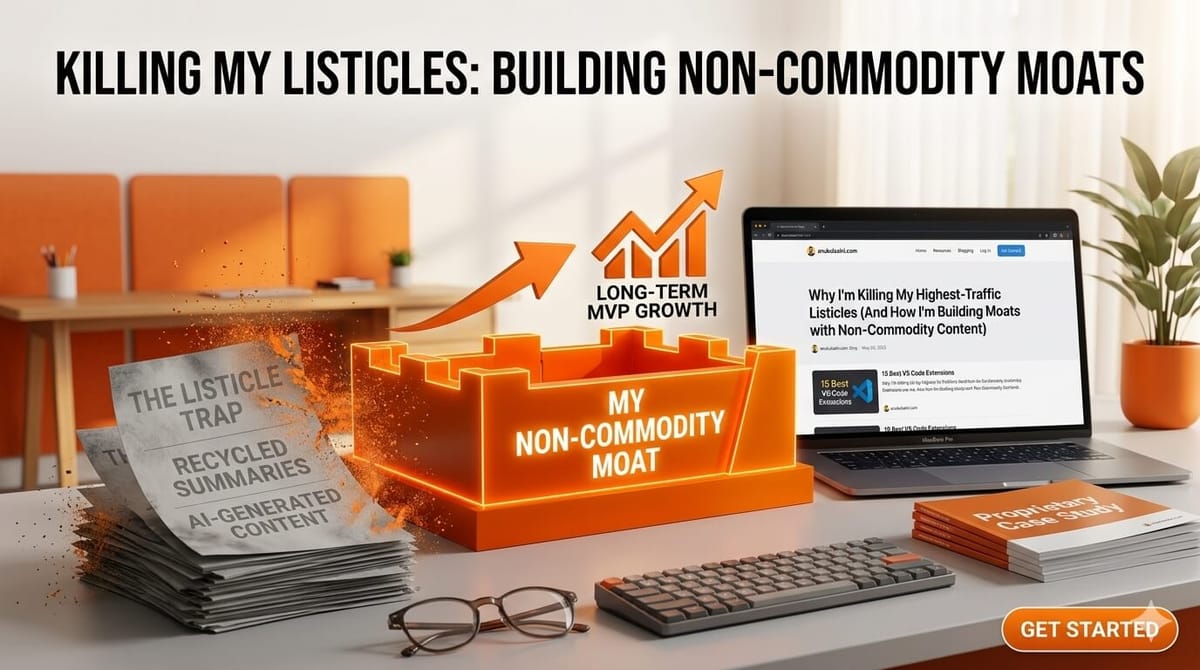
I’m hitting delete on some of the most popular pages on my site, Not literally BTW.
If you look at my blog right now, you’ll see pieces like 15 Best VS Code Extensions to Boost Developer Productivity or 15 Best Open Source CRM.
They bring in traffic. They rank. But I am intentionally walking away from them.
I am stopping all efforts to write standard listicles, basic guides, and generic tutorials.
Instead, I am refactoring my entire digital footprint around a single product thesis: Surviving the modern internet requires building an un-copyable moat of non-commodity content.
Here is exactly how I reached this conclusion as a fractional product lead, why I am shifting my strategy, and a blueprint you can use to protect your own website from the upcoming algorithmic wipeout.
Facing the Reality of "Commodity Content"
A massive structural shift happened in how search engines and AI assistants process data.
For years, content strategy was a game of keyword matching and consolidation—writing a slightly longer, prettier version of what was already on page one of Google.
That strategy is dead.
The content it produced is what the industry now calls commodity content.
What is Commodity Content?
Commodity content is generic, interchangeable information based entirely on common knowledge.
It contains zero original perspective, no proprietary data, and no firsthand evidence.
If a writer can compile an article by simply opening five top-ranking tabs on Google and summarizing them, it is commodity content.
And if a human writer can do that in an afternoon, a generative AI model can do it in three seconds.
The Example Sitting on My Own Site
Look at my article: 15 Best VS Code Extensions.
- Why it’s a commodity: The list includes tools like Prettier, GitLens, and ESLint. They are fantastic tools, but that information is public common knowledge.
- The structural flaw: A user doesn't need to visit my site to find that list anymore. They can simply ask an AI assistant or look at an AI Search Overview. The algorithm summarizes the top extensions directly on the results page, absorbing my data and cutting off my traffic loop entirely.
Why I’m Pivoting: The Product Led Moat?
As someone who helps founders scope and launch MVPs, I look at websites the same way I look at software architecture.
If your software product is just a basic wrapper UI that pulls data from a public API, you don't own a business; you own a feature that a competitor can clone in a weekend.
The same applies to content.
If your blog posts are just wrappers for public information, your traffic will be hollowed out.I don't want vanity metrics.
I don't want 10,000 casual readers who hit the back button after ten seconds.
I want technical founders, solo operators, and product managers who need real, high-stakes development strategy.
To capture that audience, every single asset on my site must prove that I have real, boots-on-the-ground experience over 6 years of building products.
That means switching entirely to non-commodity content.
What is Non-Commodity Content?
Non-commodity content is information that cannot be simulated, scraped, or generated by an AI model because it relies on first-party inputs.
It is driven by proprietary data, hand-on engineering tests, unique internal frameworks, or lived experience.
It introduces high Information Gain—giving the web fresh, novel value instead of echoing the echo chamber.
The Non-Commodity Framework: 4 Formats You Can Implement Today
If you want to protect your website or startup blog from becoming obsolete, you must stop summarizing the web and start producing primary-source material.
Here are the exact formats I am transitioning to on my site, along with actionable examples you can implement for your own brand.
1. Shift Listicles to Performance Diagnostics
Stop listing tools based on their marketing feature checklists.
Instead, put them through an actual stress test or experiment. Document the raw friction, the failures, and the exact limits of the software.
- Instead of writing: 12 Best AI App Builders for Non-Coders, Ranked
- What to do instead: Build the exact same MVP feature on three different platforms. Write a diary tracking where the code glitched, where the deployment crashed, and how much it actually cost to keep running.
- The Non-Commodity Title: I Built the Exact Same MVP on 3 Separate AI App Builders: Here is Where the Code Actually Broke.
2. Open-Source Your Internal Frameworks and Sprints
Take the internal documents, checklists, or spec files that you use to run your daily operations and turn them into public case studies.
Your unique workflow is an asset that an algorithm cannot manufacture.
- Instead of writing: How to Map Out a Product Roadmap (A Step-by-Step Guide)
- What to do instead: Open up a real, anonymized project spec sheet from a past client build. Show the exact Slack messages, the wireframe iterations, and the precise reasoning behind why a specific feature was cut from the sprint.
- The Non-Commodity Title: Inside a 5-Day Product Sprint: The Exact Spec Sheet and Wireframe We Used to Scope an AI MVP.
3. Build Interactive, Low-Code Utilities
Don't just write about a concept—build a lightweight tool that lets users experience it natively in their browser.
Software utilities create a massive moat because interactive tools cannot be easily scraped or replaced by a static text answer.
- Instead of writing: What is RICE Scoring in Product Management?
- What to do instead: Build a native, in-browser roadmap tool that calculates RICE scores automatically and exports CSVs, without forcing users to sign up or log in. (This is exactly why I built my free Roadmap Template Tool).
- The Non-Commodity Title: The Friction of RICE: Why We Rated a Founder’s Pet Feature Below Our Technical Debt.
4. Transition Review Blocks Into High-Opinion Debates
Avoid completely neutral, boring software reviews. Take a strong, definitive, and earned stance on a tool based on your professional experience.
Then, open a moderated section where other experts can challenge or back up your claims.
- Instead of writing: Ghost CMS vs WordPress: A Feature Comparison
- What to do instead: Write an unfiltered breakdown of why you migrated your personal site from WordPress to Ghost CMS on a self-hosted VPS. State your exact hosting costs and technical roadblocks, then feature direct, curated quotes from other developers who disagree with your stack choices.
- The Non-Commodity Title: Why I Ditched WordPress for a Self-Hosted Ghost CMS (And the Technical Debt I Accepted to Do It).
The Universal Test for Your Content Strategy
Before you or your team hit publish on a new article, landing page, or guide, apply The Erasure Test:
If your brand’s logo, name, and author bio were completely removed from the page, could a competitor copy and paste that exact text onto their blog without changing a single word?
If the answer is yes, take it back to the drafting board.
Inject your data logs, embed your internal screenshots, add your expert interviews, or use your live tools until that page becomes completely un-copyable.
That is how we build software, and that is how we must build content.
Now that the draft is ready, let me know if you would like to adjust any specific paragraphs, inject details about your micro-games (like Query Noir), or if this is ready to lock into your CMS.
Spotted something outdated or wrong?
Report an issue
We hate ads too. Sign up free to remove them








Comments