
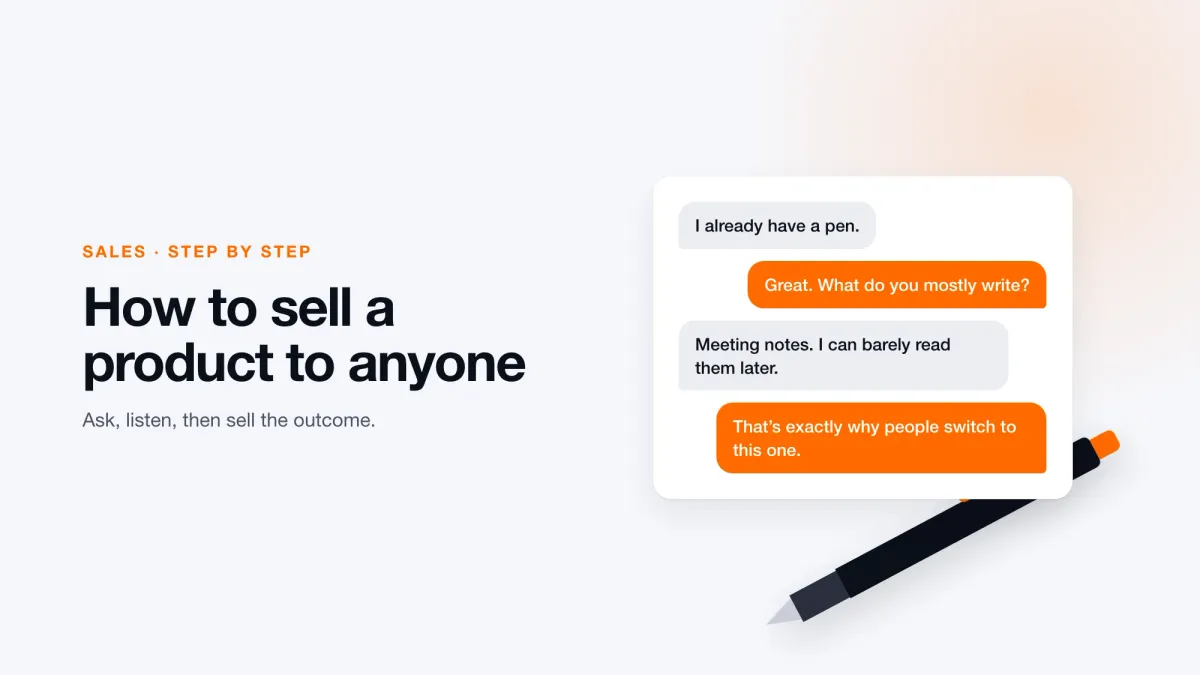
Quick answer: To sell a product, stop pitching it. Make the conversation about the buyer: ask about how they work today, uncover a problem your product actually solves, talk about the result rather than the features, back it up with a short customer story, show a little doubt about fit, and when they object, ask another question instead of arguing. This works for a pen, a SaaS subscription, a service or anything else.
Why most product pitches fail: the "sell me this pen" test
"Sell me this pen" is one of the most common sales role-plays, and most people answer it the same way:
"This is a high-quality ballpoint pen. It uses black ink, has a convenient click-to-open feature, writes smoothly and has a large ink reservoir, so it'll last you a long time."
That's a nice description of what might be a cheap disposable pen. It's also the wrong way to sell it, for three reasons:
- It's all about you. My product, my company, do you want to buy what I'm selling? That immediately flags you as a salesperson.
- It triggers guardedness. Once the buyer feels sold to, you get objections, resistance and rejection.
- The buyer isn't in buying mode yet. When you open with the product, you're talking about something the buyer isn't thinking about. That mismatch kills the conversation before it starts.
The fix isn't a better product description. It's six small changes to how you run the conversation.
Step 1: Make it about the prospect, not the product
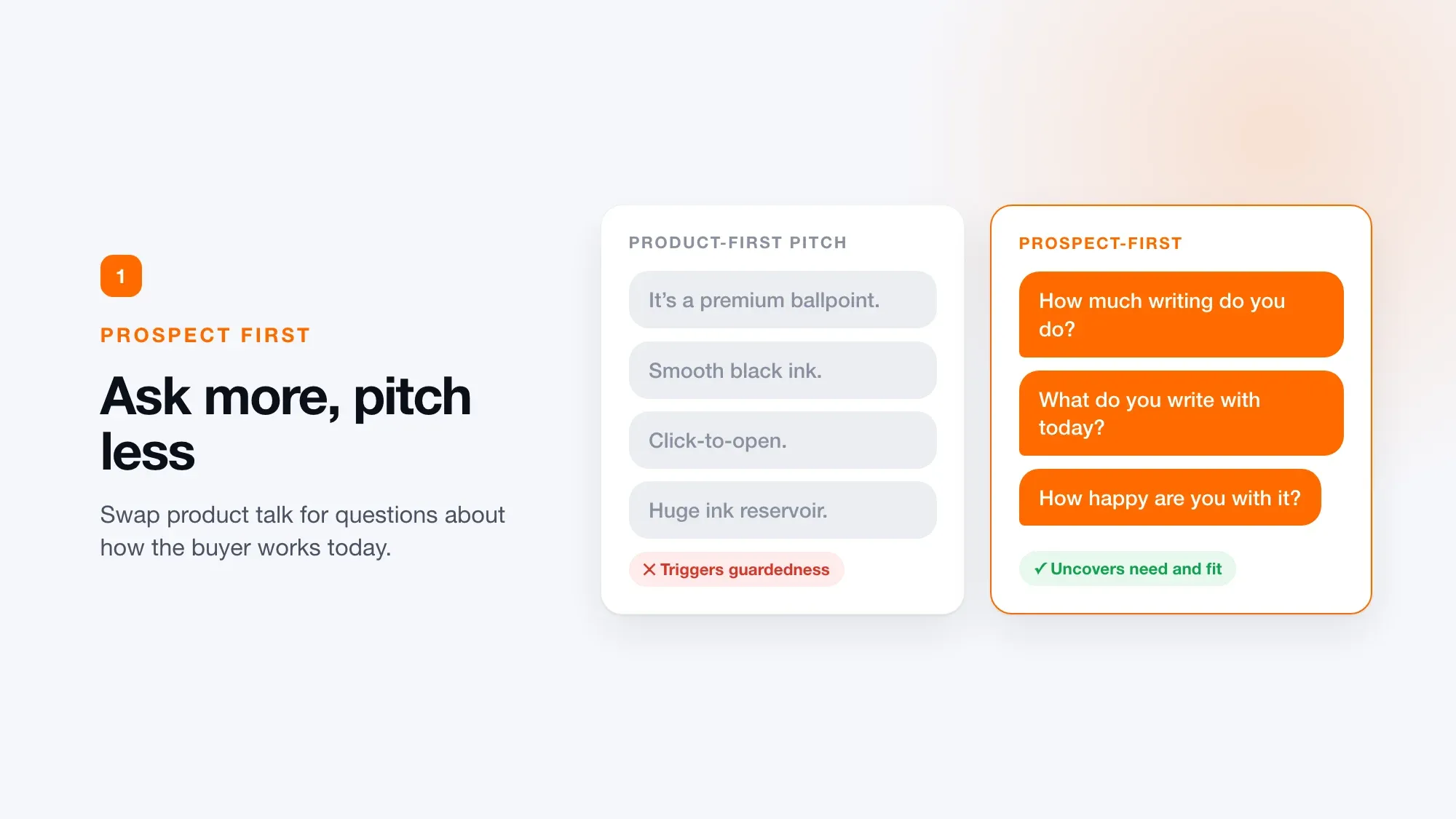
The first shift is simple: replace talking about the product with asking questions about the prospect.
If you're selling a pen, start with current-state questions: questions about what the buyer does today in the area where your product fits.
- How much writing do you typically do?
- What kind of writing is it?
- What do you usually write with?
- What pen are you using now, and how happy are you with it?
Good questions do two jobs. They help you uncover a need for what you sell, and they help you spot people who aren't a fit early. Every minute you stop spending on the wrong prospects is a minute you can spend on the right ones, and selling gets easier straight away.
Step 2: Ask pain questions tied to what you sell
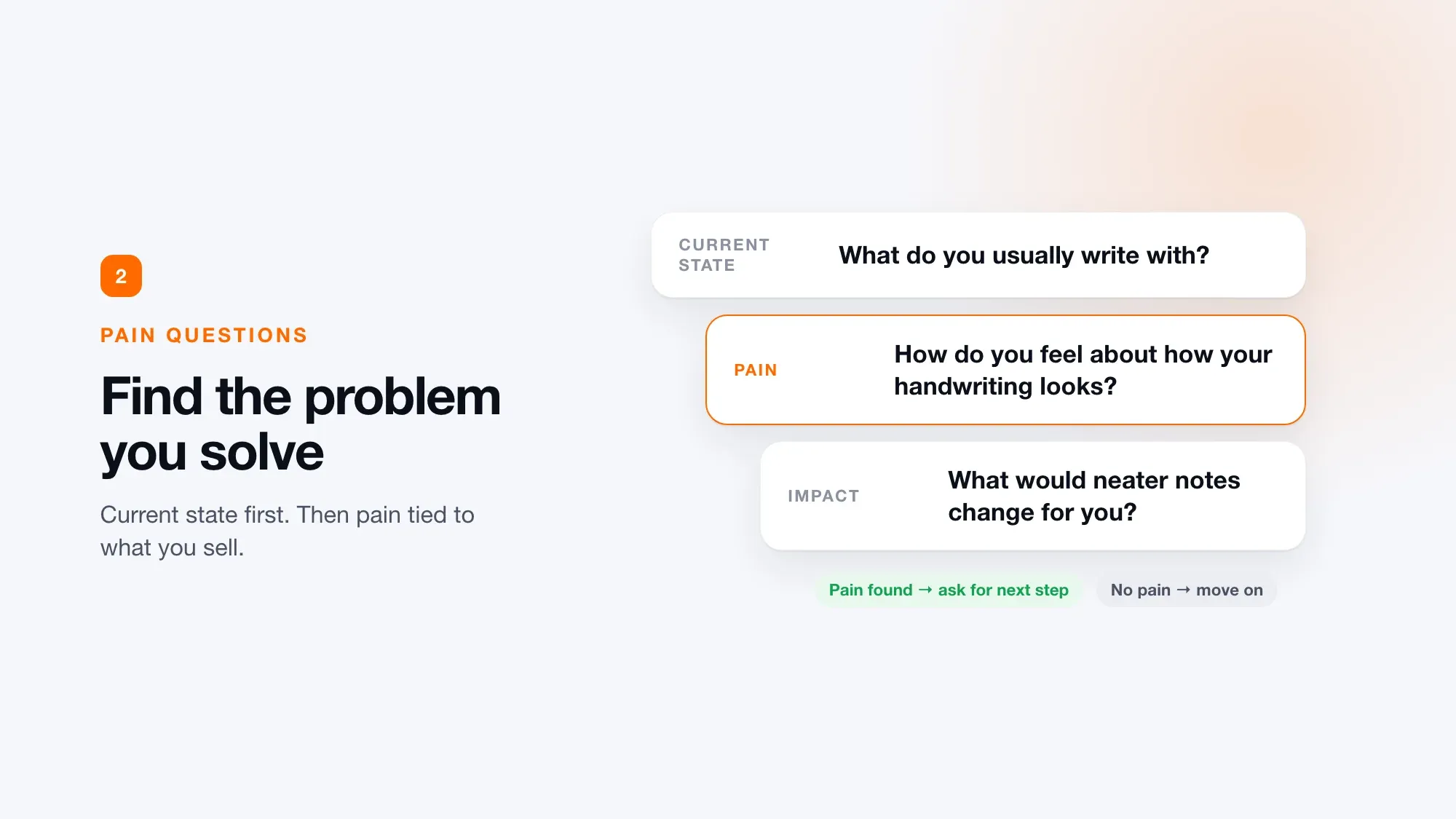
Next, get the prospect talking about their challenges. Not every challenge, only the ones your product can actually solve.
Skip generic questions like "What's your biggest challenge?" or "What keeps you up at night?" Ask pain questions aligned with the problems your product removes. For a pen, that might be:
- How do you feel about how your handwriting looks?
- How useful would it be to write faster?
- How much does the cost of good pens bother you?
The right pain questions depend on what your product solves and who you're selling to, so they'll change as your buyer changes.
Either answer is useful:
- They have the pain. What they tell you becomes your reason to ask for the next step.
- They don't. They're doing fine in the area where you sell, so they probably aren't a fit. Move on and spend that time on better prospects.
Step 3: Sell the value, not the features
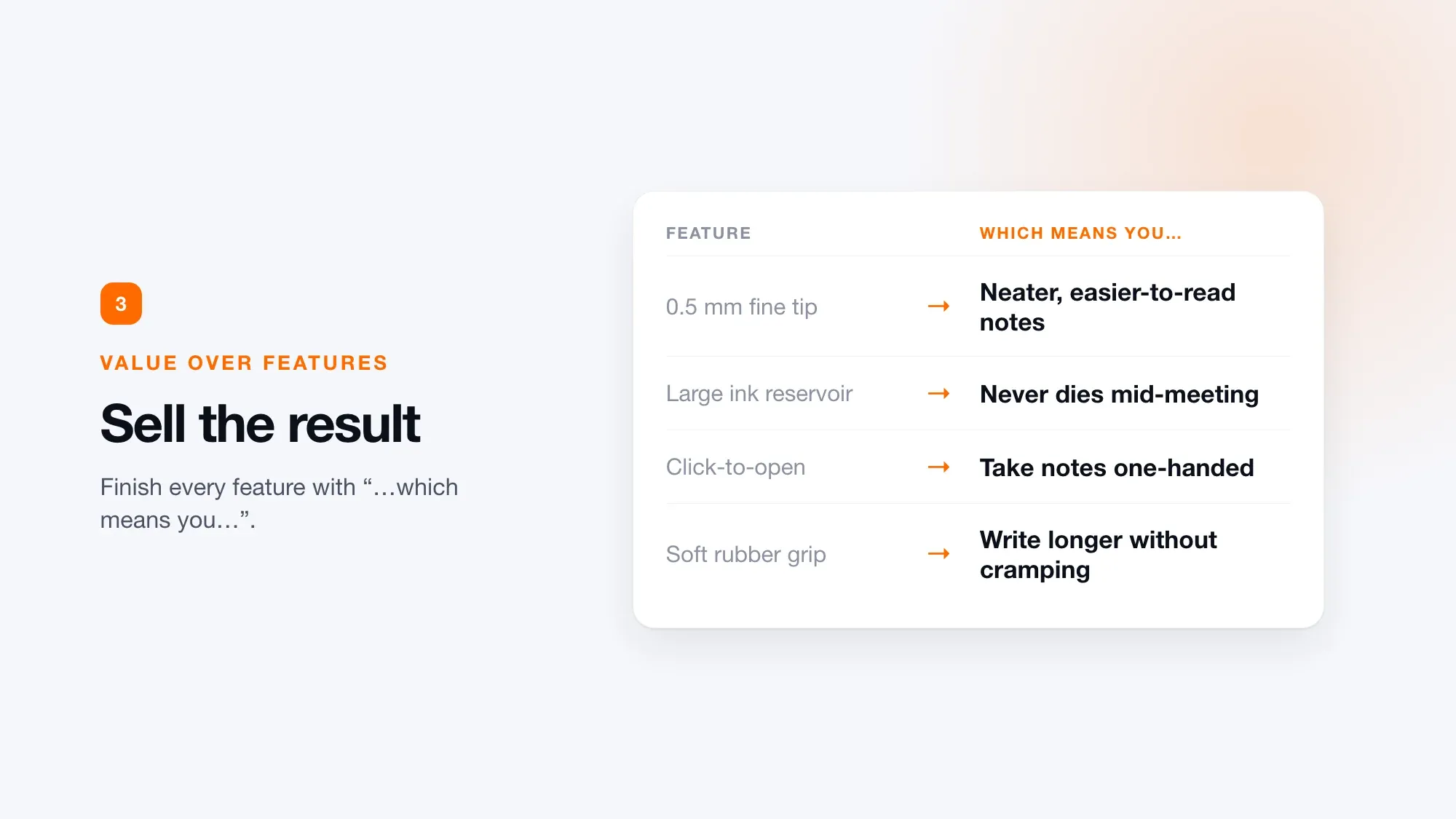
Features describe the product. Value describes what changes for the buyer. The buyer cares mostly about the second.
Instead of talking about the type of tip the pen has (a feature), talk about how it helps improve your handwriting (the result). Features still matter, but they work best as proof of a benefit, not as the pitch itself.
A quick way to translate: take each feature and finish the sentence "…which means you…"
- Fine 0.5 mm tip, which means your notes are neater and easier to read.
- Large ink reservoir, which means it won't die halfway through a meeting.
- Click-to-open, which means you can take notes one-handed.
Step 4: Use customer stories as a shortcut to credibility
Customer examples are the fastest way to explain what you sell and why anyone should believe you. Turn them into stories you can tell in under 30 seconds:
- Who they were: someone similar to the person you're talking to
- The problem they had: ideally the same pain you just uncovered
- What changed: the result, in plain numbers or plain words
For example: "We work with a lot of students who take handwritten notes in lectures. One told us they switched because their notes were unreadable by the time exams came round. After a term with this pen, they were revising from their own notes instead of borrowing someone else's."
Have three or four of these ready and use them at key moments, such as right after a prospect describes a pain that matches one of your stories.
Step 5: Use the sales takeaway
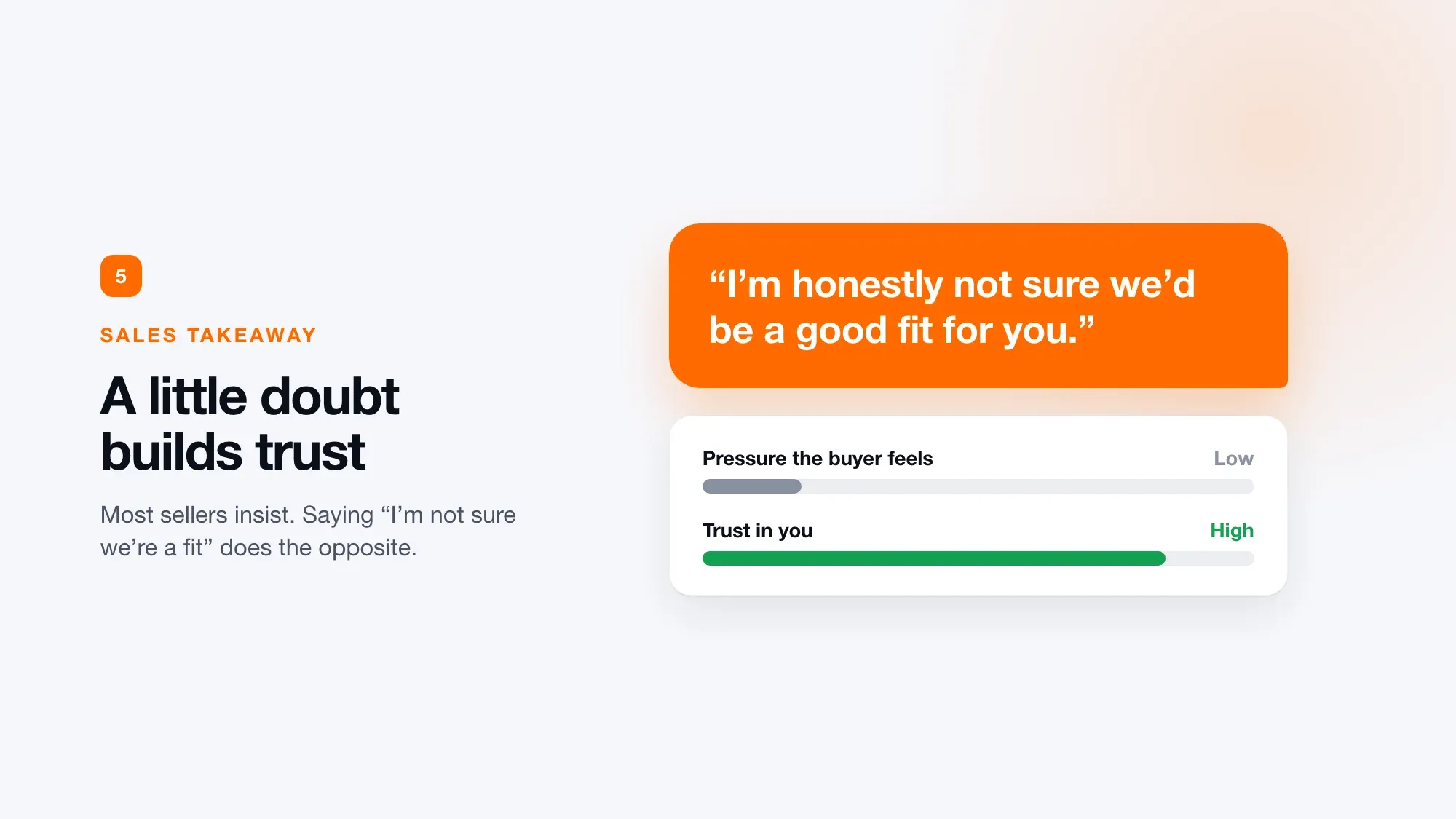
The sales takeaway means expressing a little doubt about whether the prospect is the right fit. At key moments, say something like:
- "I'm not sure if you'd be a good fit for what we do."
- "I'm not sure we can help you in the same way or not."
It works almost like a cheat code. It builds interest, rapport and credibility quickly because it's the opposite of what most salespeople do.
Pushy sellers insist everyone needs their product. When you show doubt, you instantly seem more trustworthy, and the prospect often starts persuading you.
Use it honestly. If you genuinely aren't sure about fit, say so. That's what makes it believable.
Step 6: Deflect objections instead of fighting them
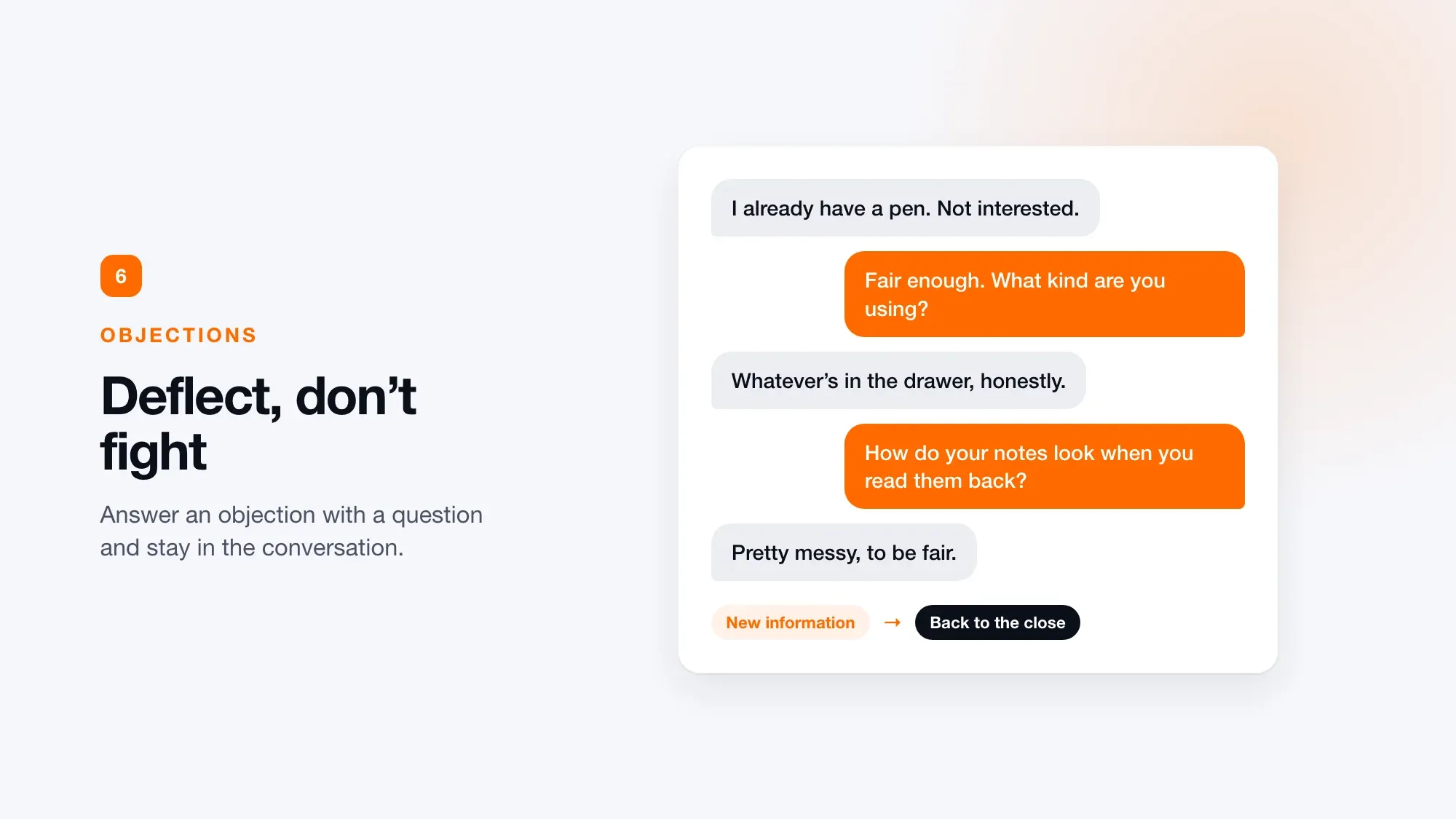
When you can't get the prospect to the next step, there's usually an objection in the way:
- "I'm not interested."
- "We already use someone for that."
- "We're not making any changes."
- "We don't have the budget."
These are hard to overcome head-on. So don't try. Deflect the objection to stay in the conversation, so you get another chance to close later.
To deflect, ask one of the questions you prepared in steps 1 and 2. If the prospect says "I already have a pen, I'm not interested," reply:
"Oh, great. What kind of pen are you using? What sort of writing do you mostly do? How do you feel about how your handwriting looks? When did you last think about switching?"
These questions keep the prospect talking and often surface new information. If what you learn gives you a reason to keep going, go back to the close and ask for the next step.
Example: how to answer "sell me this pen"
Here's how the six steps fit together in one short conversation:
You: Before I tell you anything about it, how much writing do you actually do in a week?
Buyer: A fair bit. Meeting notes, mostly.
You: What do you write with now?
Buyer: Whatever's lying around.
You: How do you feel about how those notes look when you read them back?
Buyer: Honestly, half the time I can't read them.
You: That's the main reason people pick this one up: a fine tip that keeps fast handwriting legible. One of our customers, a project manager, said it was the first time their meeting notes were usable a week later. I'm not sure it's for everyone, though. Would legible notes actually make a difference for you?
Buyer: Yeah, it would.
You: Then try it in your next meeting and see.
Notice that the pen's features come up once, as proof of a benefit the buyer has just told you they want.
Before your next sales conversation: build your building blocks
You don't need a script for every situation. You need a set of reusable building blocks you can mix and match across calls, emails, voicemails and objection responses:
- Current-state questions: 5 to 10 questions about how the buyer works today.
- Pain points: the specific problems your product removes or helps avoid.
- Pain questions: one question for each pain point.
- Benefits: each feature rewritten as "…which means you…".
- Customer stories: three or four 30-second examples.
- Objection deflections: your most common objections, each paired with a question.
Write these once for each product and each type of buyer, then reuse them everywhere. You can use an AI assistant to brainstorm a first draft, but test every line in real conversations and keep only what buyers actually respond to.
How to sell a product: summary
| Step | Instead of… | Do this |
|---|---|---|
| 1. Focus on the prospect | Describing the product | Ask current-state questions |
| 2. Uncover pain | "What's your biggest challenge?" | Ask pain questions tied to what you sell |
| 3. Sell value | Listing features | Explain the result for the buyer |
| 4. Prove it | Claiming you're the best | Tell a short customer story |
| 5. Sales takeaway | Insisting it's perfect for them | Express honest doubt about fit |
| 6. Deflect objections | Arguing with the objection | Ask a question and stay in the conversation |
Frequently asked questions
How do you sell a product to anyone?
Make the conversation about the buyer, not the product. Ask how they work today, uncover a problem your product solves, explain the result rather than the features, back it up with a short customer story, and handle objections by asking another question instead of arguing.
What is the best way to answer “sell me this pen”?
Don’t describe the pen. Ask questions first: how much they write, what they use now and how they feel about their handwriting. Once they name a problem, explain how the pen solves it, share a quick example, and ask for a small next step.
What questions should you ask when selling a product?
Start with current-state questions about how the buyer works today, such as what they use now and how happy they are with it. Then ask pain questions tied to the specific problems your product solves. Avoid generic questions like “What’s your biggest challenge?”
What is the difference between features and benefits in sales?
A feature is what the product has, like a fine 0.5 mm tip. A benefit is what changes for the buyer, like neater, easier-to-read notes. Lead with benefits and use features as proof.
What is the sales takeaway technique?
The sales takeaway means honestly expressing doubt about whether the buyer is a good fit, for example “I’m not sure we’d be a good fit for you.” Because most salespeople do the opposite, it lowers pressure, builds trust and often makes the buyer more interested.
How do you handle sales objections like “I’m not interested”?
Don’t argue with the objection. Deflect it with a question, such as “What are you using now?” or “How is that working for you?” This keeps the conversation going and often uncovers new information that gives you a reason to ask for the next step again.
How can I sell a product without being pushy?
Ask more than you talk, only pursue buyers who actually have the problem you solve, and be willing to say a product isn’t right for someone. Buyers trust sellers who qualify them out as readily as in.
Spotted something outdated or wrong?
Report an issue
We hate ads too. Sign up free to remove them







Comments