
In 2019, I was sitting on my couch, done with an anime I'd just binged in 3 days, and completely stuck.
What do I watch next?
There was no good answer anywhere. Reddit threads were a mess. Google results were generic. Nobody was writing like they'd actually watched the show. Nobody understood why you loved what you loved, or could point you to something that'd hit the same way.
So I built something. Not a startup. Not a "media company." Just a blog. For me.
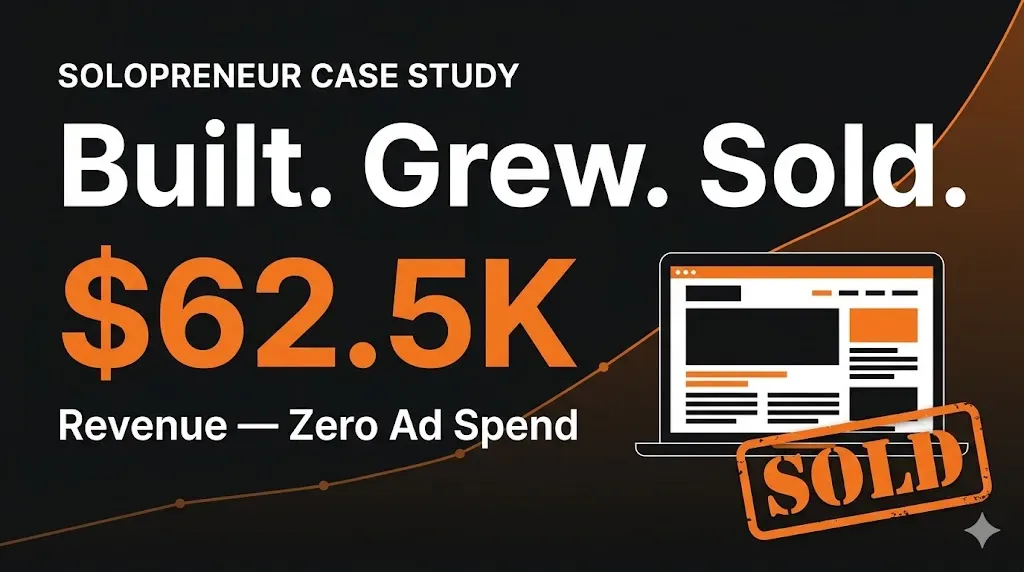
Five years later, I sold it.
The Problem I Was Scratching
Here's the thing about anime — it has a culture. It has original lore, community theories, inside jokes, character arcs that run 200 episodes deep. You don't just "consume" anime. You live in it for a while.
But almost every content site treating it like a news ticker. Dry summaries. Top 10 lists written by people who clearly hadn't watched the shows. Zero community. Zero depth.
What was missing:
- A place where someone could find their next anime based on what they actually felt about the last one
- Fan theories that went deep — not just "here's the plot"
- A space where the community could actually talk, debate, and geek out
I wasn't thinking about traffic or revenue when I identified this. I was the user. I was feeling the gap every single time I finished a show and had nowhere good to go. That's the most honest origin story I can tell you.
What I Actually Built?
I started with a simple WordPress blog. Nothing fancy. Twenty to twenty-five articles, all written by me.
The angle was simple — I watched what my readers watched. I understood the source material, the culture, the original Japanese context. I wasn't giving general info. I was having the same conversation they were having in their head, just in written form.
Early content was all over the place — reviews, theories, rankings. But slowly I figured out what people were actually searching for and coming back for.
There were no tools, no team, no revenue. Just a guy who loved anime, writing about it.
The Inflection Point — 10,000 Users
When MOW crossed 10K users, something shifted in my head.
This wasn't just a personal blog anymore. Real people were reading this regularly. Coming back. Sharing it with other otakus. And I hadn't promoted it anywhere — they just found it.
That's when I decided to go all-in. Here's what I actually changed:
- Overhauled the entire blog — new structure, better UX, cleaner design
- Opened comments on every article to invite discussion and build community interaction
- Hired 2 content writers who were genuine anime fans — not just SEO writers who'd do surface-level research
- Doubled down on content volume — publishing consistently, targeting long-tail queries that nobody else was answering well
I didn't quit my job. I was still working full-time. But I stopped treating MOW like a hobby and started treating it like a product.
The Growth Engine
Here's the loop that drove everything:
Content → SEO Rankings → Organic Traffic → Readers Sharing → More Traffic → More Content Needed → Better Writers → Better Content
The two content types that drove the most growth were rankings/listicles and fan theories.
These had two things going for them — high search intent (people actively looking for "best isekai anime" or "explanation of Attack on Titan ending") and high shareability (otakus love debating rankings and theories with each other).
Traffic breakdown at peak was roughly:
- SEO and organic search — the majority, across Google and Bing both
- Social shares — readers organically sharing articles with fellow fans
- Direct traffic — almost 20% — which is a strong signal that people were bookmarking us and coming back on their own
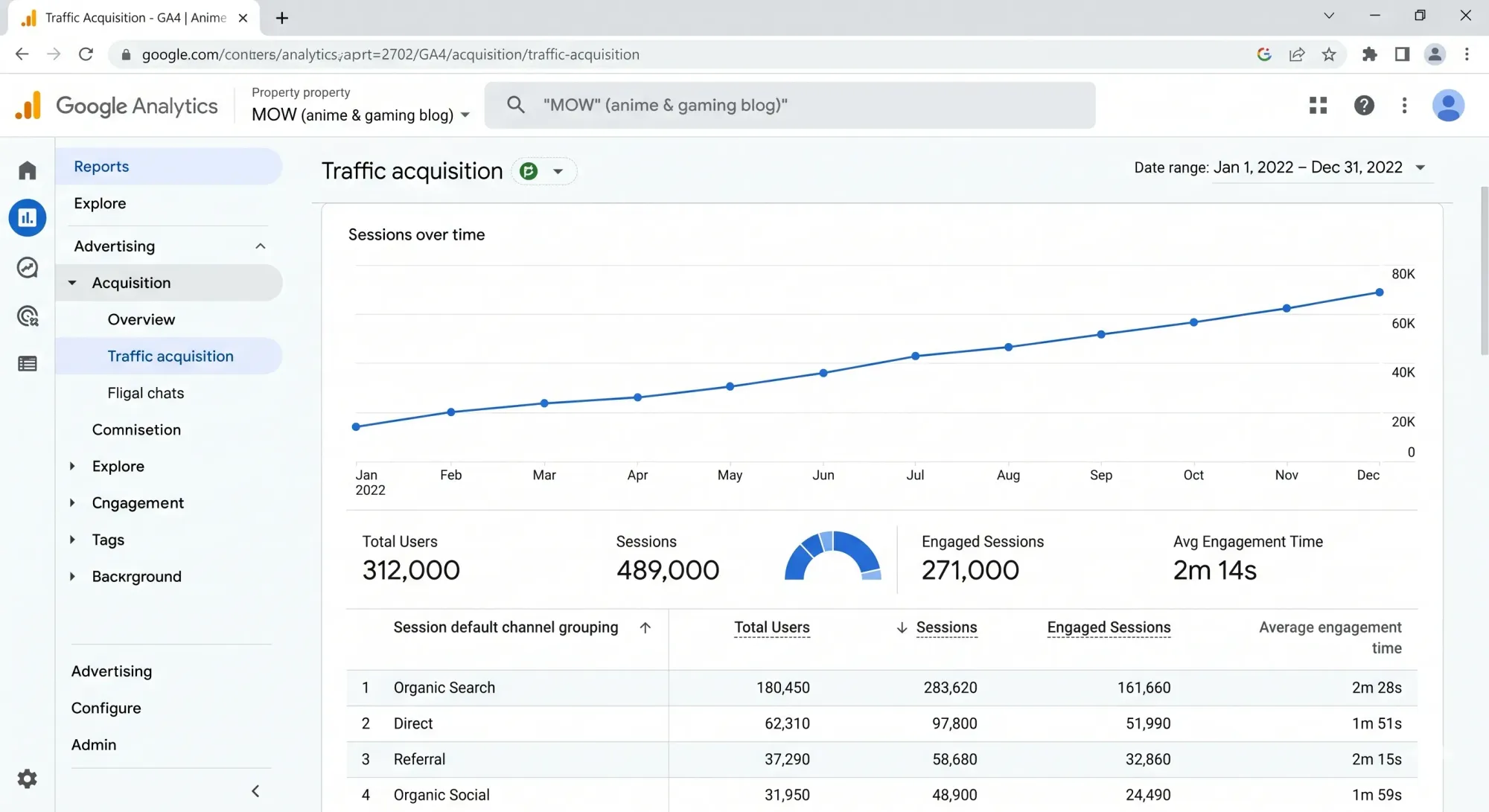
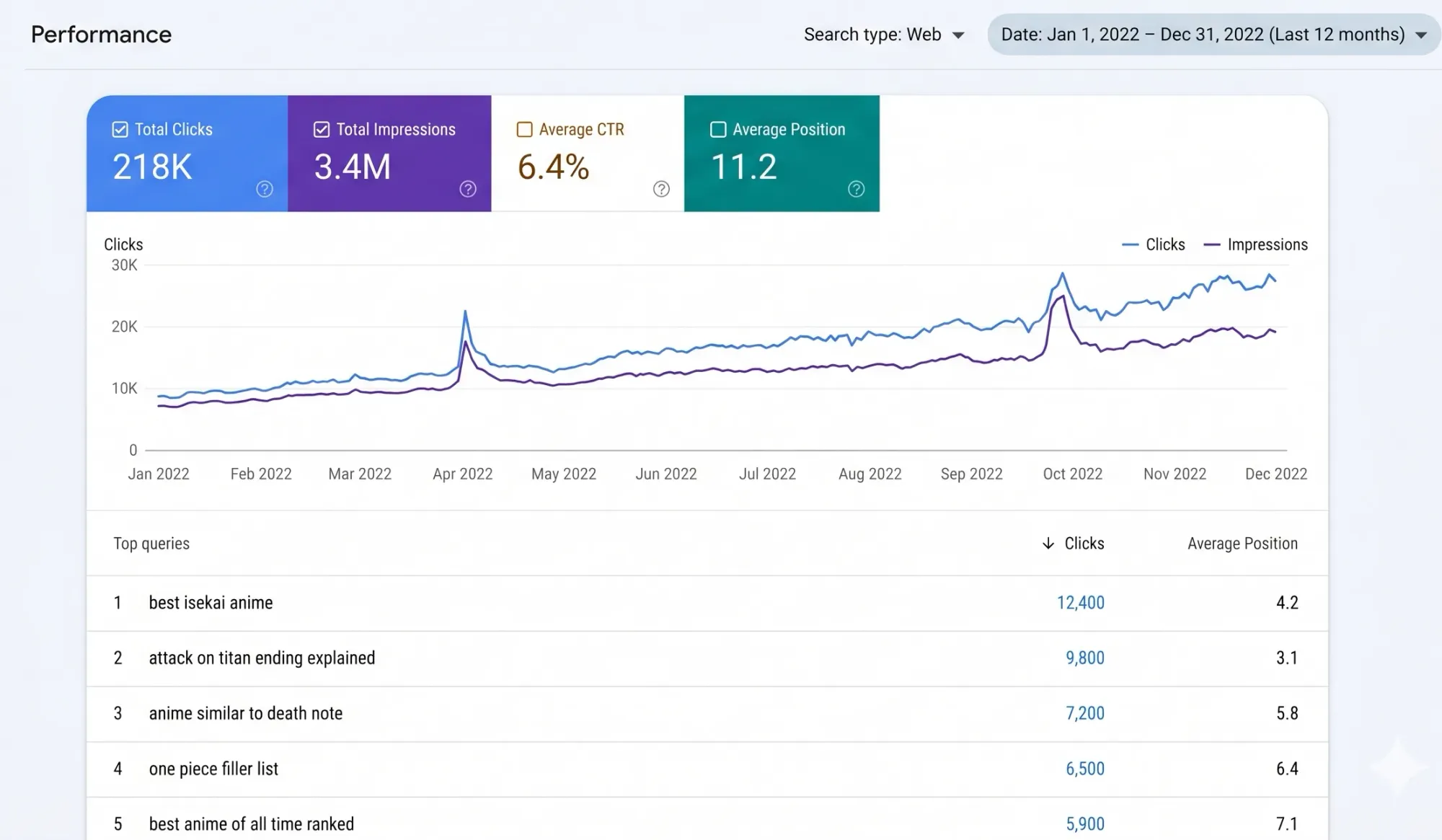
No paid acquisition. Not a single rupee spent on ads to drive traffic. It was entirely earned.
When I expanded into gaming content, I built small browser tools — name generators, story generators, and a voting system so users could vote for their favorite anime and characters in list articles.
These were simple tools but users loved them. They gave people a reason to stay on the site longer and interact with content, not just read and leave.
The Team at Peak
At the highest point, MOW had 10–12 people involved:
- Content writers (the core team — all anime/gaming enthusiasts first, writers second)
- SEO specialists
- A WordPress developer for the site and tools
I kept the org flat. Everyone knew what they were working on. No project management overhead.
The content team essentially ran itself because they were genuinely passionate about the niche — I didn't have to push them to stay updated on new anime drops.
Monetisation — How 62.5k USD Happened
Honest answer: I left money on the table.
The only revenue stream MOW ran on was display ads — Google AdSense and programmatic display. That's it.
No affiliate deals. No brand sponsorships. No paid newsletters. Nothing.
Why?
Because I was running this alongside a full-time job, and keeping monetisation simple meant I could keep my headspace free. I didn't want to manage brand relationships or affiliate programs on top of everything else.
My first earnings came about 6 months after launch — roughly $100 from Google AdSense. That $100 hit different. It wasn't the amount. It was proof that this was real.
The revenue grew slowly at first, then started compounding as SEO kicked in properly. By the time I was thinking about an exit, MOW was generating $4,000–$5,000 a month consistently.
The $62.5k didn't come in one month. It was the cumulative result of 4–5 years of traffic growing, content compounding, and display ad revenue stacking up.
If I had added affiliate links to anime merch, streaming platforms, or gaming gear — and layered in one or two brand sponsorships — the revenue could realistically have been 2x or 3x.
I know that now. At the time, simplicity felt like the right trade-off, and I don't regret it.
The Exit — Deciding to Sell
Nobody knocked on my door. I went looking for a buyer.
The decision came from two places:
First, I wanted to build something new. I had a new idea and I needed both the mental bandwidth and the capital to pursue it. MOW was running well but it needed a dedicated owner who could take it to the next level — someone for whom this was the primary focus, not a side project.
Second, the revenue was at a place where a sale made financial sense. At $4–5K/month, the site had real value as an asset. I knew I could convert years of work into upfront capital that I could redeploy into the next thing.
The process was straightforward. I listed the asset, found a buyer who understood the niche, and closed the deal. I won't share the exact multiple or final number — but the outcome funded what came next.
What I'd Do Differently
A few honest ones:
1. Expand the feature set earlier. MOW was mostly a content site. But I had the traffic and the community to build something stickier — a community forum, a personal watchlist creator, an anime recommendation engine, a user-generated review system. If I had built MOW into a one-stop solution for anime fans, retention would have been stronger and the exit valuation much higher.
2. Diversify revenue from day one. Display ads are the laziest monetisation model. They work, but they leave a lot behind. Even one well-placed affiliate partnership or one annual sponsorship deal per quarter would have changed the numbers significantly.
3. Timing. I could have gone all-in earlier. The gap was there before I fully committed to it. I was cautious because of my job. That caution cost me roughly 1–2 years of compounding growth.
What This Taught Me About Building Products
This is the part I think about the most.
MOW worked not because of the tech, or the SEO strategy, or even the content volume. It worked because I was the user. I built for myself first, and it turned out there were thousands of people who had the exact same problem.
Four principles I now apply to every product I build or evaluate:
- Start with the user, not the idea. The best products I've seen — including the ones I've worked on professionally — start with a felt pain, not a clever solution looking for a problem.
- Relevance beats expertise. I wasn't the most qualified person to write about anime. But I was the most relevant. I had watched what my readers watched. I understood what they felt. That authenticity came through in the content and people trusted it.
- Simple loops beat complex strategies. The growth at MOW came from one loop that kept feeding itself. I didn't need a 12-channel marketing plan. I needed one thing that worked and then I needed to keep doing it.
- Your product is only as good as the reason people stay. Traffic gets people in the door. Features, community, and tools keep them. I got the traffic right. I underinvested in retention. That's a mistake I won't repeat.
Building something of your own? Even if it's a side project — start with the problem you feel every day. That's the most honest product brief you'll ever write.
Spotted something outdated or wrong?
Report an issue
We hate ads too. Sign up free to remove them









Comments