
I've sat in roadmap planning meetings where the backlog had 200+ feature requests. Everyone had an opinion. The sales team wanted their enterprise client's ask. The CEO had seen a competitor launch something shiny. Support was screaming about a bug that had existed for eight months.
At the end of the meeting, we had a "roadmap." It was basically a list of everything everyone wanted, arranged by who shouted loudest.
That's not a roadmap. That's a wishlist with a Gantt chart pasted on top.
I've seen this play out inside product teams, and I've made the same mistake myself when building solo. The instinct is to collect requests and start planning. But the actual job is to decide what not to build — and be clear about why.
A great feature roadmap isn't a promise. It's a prioritization decision made visible to your team.
What Is a Feature Roadmap?
A feature roadmap is a plan that shows which features you're building, in what order, and why.
Simple enough. But here's where most articles get sloppy — they use "product roadmap" and "feature roadmap" as if they mean the same thing. They don't.
A product roadmap is the big picture. It shows where the product is going over the next 6–18 months — goals, themes, bets. It's strategy-level.
A feature roadmap zooms in. It answers: given our product goals, which specific features are we building, when, and for whom?
Think of it this way: the product roadmap says "we're expanding into enterprise." The feature roadmap says "so we're building SSO, role-based permissions, and audit logs in Q3."
Who actually uses a feature roadmap:
- PMs — to make and defend prioritization calls
- Engineers — to know what's coming and plan capacity
- Founders building solo — to avoid building in circles
- Stakeholders — to understand why their request isn't in Q2
Why Most Feature Roadmaps Fail
I've seen roadmaps fail in three specific ways, and I've been guilty of at least two of them.
1. Built by HiPPO opinion
HiPPO = Highest Paid Person's Opinion. When the CEO says "we need X" and it lands on the roadmap without any data behind it, you've already broken the process. The feature might ship. It just won't move any metric.
2. No prioritization framework
When everything is "high priority," nothing is. If your team can't explain why feature A is above feature B, your roadmap is just a sorted to-do list. The next strong opinion will reshuffle it.
3. No connection to a business goal
This one is subtle but deadly. You ship the feature. Users use it a little. Nobody knows if it worked. That's because the feature was never tied to a goal — reduce churn, increase activation, grow revenue. Without that connection, you can't measure success or justify the next decision.
When I started building tools for this site, I had a running list of 10–12 ideas I wanted to ship. No priority order. No goal attached to any of them. Just "these would be cool to have."
I spent almost two weeks building one of the more complex ones — a Diff Checker tool with saved history, localStorage, multiple tabs, the works. Built it. Shipped it. Crickets.
Nobody used it. Not because it was bad — it actually worked fine. But because it solved a problem that maybe 2% of my audience had. I had skipped the one question that matters: does this move anything for the people I'm actually trying to help?
The tools I built after that — the ones I tied to a specific user need or a content goal first — those got used. One of them still gets traffic from search every week.
That's when the process changed. Feature first, then goal used to be my default. Now it's goal first, then feature. Sounds like a small flip. It isn't.
Types of Feature Roadmaps
There's no one format that fits every team. Here are three that actually get used:
Now-Next-Later
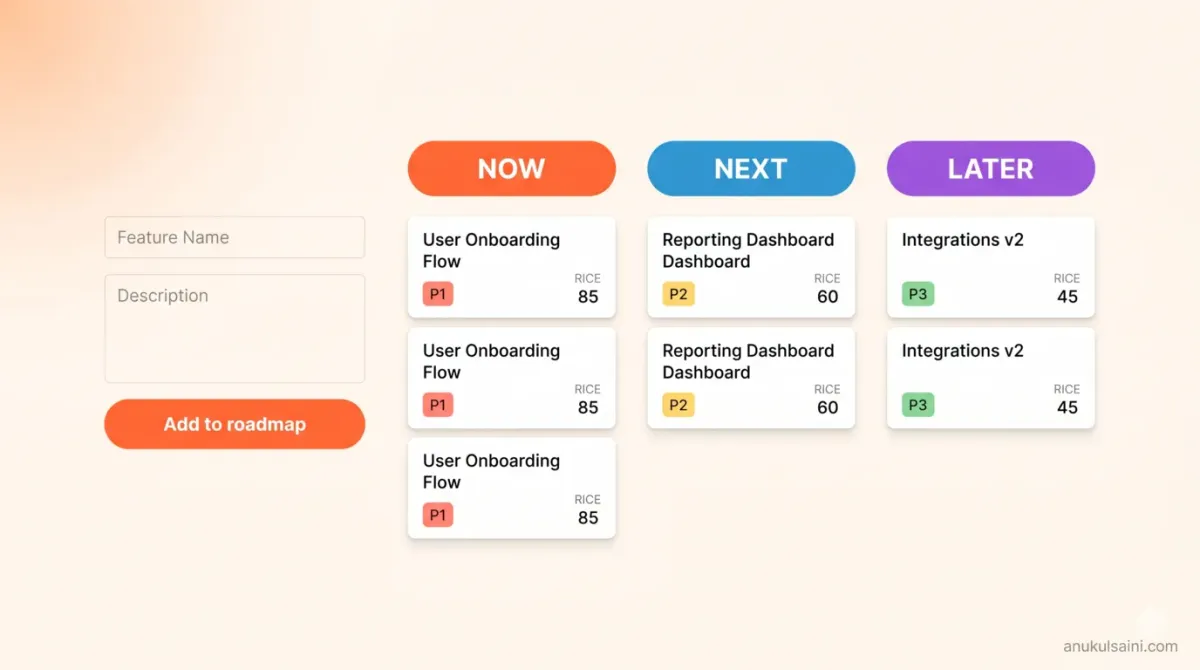
No dates. Just three buckets: what you're building now, what's coming next, and what's on the radar but not committed. This is my default for early-stage products and solo builds. It's honest — it doesn't pretend you know what Q4 looks like when you're still figuring out Q2.
Timeline-based
Quarters, months, sprints. Features mapped to a time axis. Works well when you have a stable team, predictable velocity, and stakeholders who need hard dates. The risk: timelines become commitments. Miss one and trust erodes.
Opportunity-based
Features are grouped by the user problem or opportunity they solve, not by when they ship. This forces you to stay outcome-focused. Great for teams doing continuous discovery. Slightly harder to communicate to non-PM stakeholders.
Quick guide — which to use:
- Early-stage or solo → Now-Next-Later
- Funded startup with a team → Timeline-based
- Discovery-heavy product team → Opportunity-based
How to Build a Feature Roadmap
Here's how I actually do it, step by step.
Step 1: Start with the goal, not the feature list
Before you open a spreadsheet, write down the one or two product goals for the next quarter. Increase free-to-paid conversion? Reduce day-7 churn? Every feature you put on the roadmap should link back to one of these. If it doesn't, it doesn't belong — at least not now.
Step 2: Collect inputs from everywhere
User interviews, support tickets, NPS responses, sales call notes, analytics drop-off points. Cast a wide net. The goal isn't to build everything you hear — it's to spot patterns. When five different users say "I can't find X," that's a signal. When one enterprise client requests a niche configuration, that's noise (unless you're going enterprise).
Step 3: Prioritize using a framework
This is where most people get lazy and just use gut feel. I'll cover the frameworks in detail in the next section, but the point is: use something repeatable. RICE, MoSCoW, Effort/Impact — pick one and stick to it for a cycle. Gut feel is useful input, not a process.
Step 4: Sequence into Now / Next / Later
Once you have priority scores, sequencing becomes more mechanical. High priority + low effort = Now. High priority + high effort = depends on how critical it is. Low priority + anything = Later or cut.
Step 5: Share it, get alignment, keep it alive
A roadmap nobody has seen is a document. Share it with your team, walk through the reasoning, and invite pushback before you're mid-sprint. And revisit it — monthly at minimum. A roadmap that hasn't been updated in three months is lying to someone.
Feature Roadmap Prioritization Frameworks
This is the part most articles gloss over, so let me be specific.
RICE Score
RICE stands for Reach, Impact, Confidence, Effort.
RICE Score=Reach×Impact×ConfidenceEffortRICE Score=EffortReach×Impact×Confidence
- Reach — How many users does this affect per quarter?
- Impact — How much will it move the metric? (Score 0.25 to 3)
- Confidence — How sure are you? (High = 100%, Medium = 80%, Low = 50%)
- Effort — How many person-months does it take?
A feature with Reach 500, Impact 2, Confidence 80%, Effort 2 months scores 400. Compare that across features and you have a ranked list that isn't based on who argued harder.
You can use my RICE Score Calculator tool for this also.
MoSCoW Method
Buckets features into Must-have, Should-have, Could-have, Won't-have. Less math, more judgment. Works well in stakeholder conversations because it's easy to explain. Weakness: "Must-have" tends to bloat over time as everyone fights to get their feature in that bucket.
Effort vs. Impact Grid
A simple 2x2. High Impact + Low Effort = do it now. High Impact + High Effort = plan carefully. Low Impact + anything = deprioritize or cut. I use this for quick solo decisions when I don't have time for full RICE scoring.
My personal default: I use RICE when I need to defend a call to stakeholders. I use the Effort/Impact grid when I'm moving fast solo. MoSCoW I use mostly during quarterly planning with non-PM stakeholders because it's the easiest to explain in a 30-minute meeting.
Feature Roadmap Template (Free)
Here's a simple structure that works whether you're in Notion, Google Sheets, or even a plain table:
| Column | What to fill |
|---|---|
| Feature Name | Short, clear name |
| Goal it serves | Which product goal does this map to? |
| User segment | Who is this for? |
| Priority score | RICE or Effort/Impact rating |
| Status | Idea / Planned / In progress / Done |
| Owner | Who's responsible |
| Target quarter | Q3 2026, etc. |
Feature Roadmap Template Tool
Build your product roadmap in the browser. Auto-calculate RICE scores, organise features into Now / Next / Later, and download CSVs for Excel or Google Sheets. No signup, no backend.
Keep it simple. You don't need a tool that auto-calculates velocity if your team is three people. The best template is the one your team actually opens every week.
Feature Roadmap Examples
Example 1 — Early-stage SaaS, solo builder (Now-Next-Later)
Imagine you're building a writing tool. Your activation metric is "user completes first draft." Your roadmap looks like this:
- Now: Rich text editor, auto-save, export to PDF
- Next: Templates library, keyboard shortcuts
- Later: AI suggestions, team collaboration, version history
No dates. No quarterly columns. Just a clear sense of what matters right now and what can wait. Every feature in "Now" connects to getting a user to complete their first draft.
Example 2 — Mid-size product team (Timeline-based, Q3–Q4)
A B2B SaaS team with a goal of reducing onboarding drop-off by 30%:
- Q3: In-app onboarding checklist, empty state improvements, tooltip walkthroughs
- Q4: Onboarding email sequence, product tours for power features, success milestone notifications
Each feature is mapped to the same goal. The team knows what done looks like. Stakeholders know what's coming and when.
Here's one from my PM work — names changed, but the situation is real.
We were a growth-focused product team. Our north star metric was activation — getting new users to their first meaningful action inside the product. The number had been stuck for two quarters.
In the roadmap review, three things were fighting for Q3: a redesigned onboarding flow, a new dashboard widget that a key account had requested, and a bulk export feature the sales team kept bringing up in every meeting.
The dashboard widget was loudest because of who asked for it. The export feature had "sales velocity" written all over it. The onboarding redesign had no internal champion — just data.
We picked the onboarding redesign anyway. Not because everyone agreed. Because when we ran RICE scores, it was the only one that touched the metric we actually cared about. The other two had high noise, low signal.
Activation went up. The dashboard widget shipped next quarter. The bulk export is still in Later.
That's the job. Not building what's loudest. Building what's connected.
Common Mistakes to Avoid
Treating the roadmap as a customer commitment
The moment you share your roadmap externally and a customer screenshots "Feature X — Q3," you've made a promise. Be careful what you share publicly. Share themes and goals, not specific feature timelines.
Not revisiting it
A roadmap you built in January and haven't touched by March is already wrong. Something shifted — a user insight, a business priority, an eng estimate that turned out to be off. Revisit it monthly, minimum.
Building for edge cases first
It's tempting to solve the loud customer's unusual workflow. But if 80% of your users can't get through a basic job-to-be-done, the edge case doesn't matter yet. Build for the core path first.
Over-detailing the far future
You don't know what Q4 looks like with enough precision to list features. Write themes for anything beyond 2 quarters. Save feature-level detail for what's actually in front of you.
How I Manage Feature Roadmaps
Inside a product team, my roadmap lives in Notion. I run a monthly review with eng and design, a quarterly review with leadership. The format is timeline-based because we have stakeholders who need dates — but I'm honest about confidence levels. "Q3 — high confidence" vs. "Q4 — directional" means something.
When I'm building solo, I keep it much lighter. A simple Now-Next-Later table in Notion or even a notes app. The discipline isn't in the tool — it's in the habit of asking "does this feature connect to what I'm trying to move right now?" before I add anything.
The one thing that changed how I build roadmaps: I stopped writing features first and started writing the goal first. Sounds obvious. Very few people actually do it. When the goal is written at the top of the doc, every feature either belongs or it doesn't. The debate gets shorter.
My tool stack is embarrassingly simple for someone who writes about product.
Inside a team: Notion for the roadmap doc, Linear for execution, and a shared Google Sheet when stakeholders need something they can filter without learning a new tool. That's it.
When building solo on anukulsaini.com: everything lives in excel sheet. One database. Features as rows, goal, status, effort, and target week as columns. I open it every Monday morning and ask one question — "is what I'm working on this week actually connected to what I'm trying to grow?" Most weeks, the answer is yes. Some weeks I have to move something back to Later and it stings a little.
The most useful thing I ever did was add a "Why Now" column to my solo roadmap. Not just what the feature is — but why it matters this week over everything else. Turns out, when you can't answer that in one line, the feature probably doesn't belong in Now.
And I realise that knowing what not build is more important then what to build.
I cut a tool from my roadmap three times before I finally deleted the row. Every time I moved it back to Later, I told myself "next quarter." When I finally killed it, nothing broke. No user asked where it went. That's how I know it was never really a priority — I had just convinced myself it was because it was technically interesting to build.
Final Thoughts
A feature roadmap isn't a list of things you'll build. It's a public record of your priorities — and your reasoning behind them.
The best ones are honest about uncertainty, connected to real goals, and updated often enough to actually reflect where the product is going.
Build it like a decision log, not a promise sheet.
If you want to use the template I described above, grab it here . And if you want more frameworks like this in your inbox, join my newsletter.
Spotted something outdated or wrong?
Report an issue
We hate ads too. Sign up free to remove them







Comments