
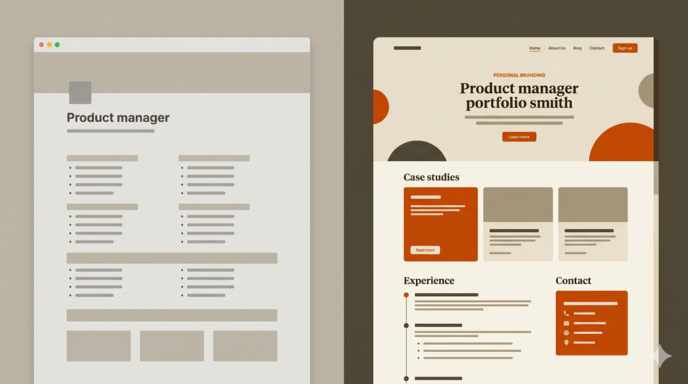
Let me say something uncomfortable upfront: 89% of hiring managers say they rarely or never look at PM portfolios. So if you've spent hours polishing a Notion case study page, that's a hard pill to swallow.
But here's the thing — that stat isn't an argument against having a portfolio. It's an argument against having the wrong kind.
Most PM portfolios look identical. A Notion page, three case studies, one metric that sounds impressive ("increased conversion by 23%!"), and zero proof of how the person actually thinks. I've seen them. I've made one. And I knew the moment I finished it that it was forgettable.
So I stopped. I looked at my blog — anukulsaini.com — and realized I already had a portfolio. I just hadn't framed it that way. I rewrapped my entire site around my thinking, not my job titles. And that shift changed everything.
This is what I learned.
The Real Problem With PM Portfolios
The problem isn't that you don't have one. It's that everyone's is the same.
Most portfolios show outputs, not thinking. "Launched Feature X. Boosted retention 15%." Cool. But what were the three alternatives you considered and killed? What did the data tell you that your intuition got wrong? What did you fight for in a roadmap prioritization meeting that nobody agreed with until it worked?
None of that shows up in a standard case study.
The format itself is borrowed from designers and engineers — fields where the output is the proof. A designer shows you the screen. An engineer shows you the working code. But a PM's work is largely invisible. It lives in decisions, conversations, trade-offs, and judgment calls. A polished PDF doesn't capture any of that.
There's also a deeper credibility problem. Elaborate case studies about small projects come across as try-hard. Generic descriptions of features reveal nothing about how you think. And fake redesigns of apps you've never worked on? Hiring managers can smell those from a mile away.
What Hiring Managers Actually Want (And Why Most Portfolios Miss It)
Here's the honest reality of that 89% stat: hiring managers don't skip portfolios because they don't care about your work. They skip them because most portfolios don't tell them what they need to know.
What they're actually evaluating in any PM hiring process is this:
- Can you think clearly under ambiguity?
- Do you have strong product sense?
- Can you communicate your reasoning without a slide deck?
- Do you have a point of view — and can you defend it?
A standard case study page answers none of these questions well. It shows you can format. It doesn't show you can think.
What actually signals strong product sense is written content — posts, analyses, breakdowns — where your real opinions show up. Not "here's the framework for good PM work." But "here's why I think this product is broken, here's what I'd do differently, and here's the trade-off I'd accept to get there."
That's what gets people hired, followed, and trusted.
Why I Rewrapped My Blog as My Portfolio
I'll be honest — building a traditional PM portfolio felt fake to me.
I'd open Notion, stare at the case study template, and realize I was about to describe my own work in a way that made it sound like a consulting deck. Polished, impersonal, designed to impress. Not how I actually think about products.
At the same time, I had been writing at anukulsaini.com for a while. Posts about system design for PMs. Posts about building browser-based tools from scratch. Posts about migrating my own site from WordPress to Ghost CMS — documenting every decision, every trade-off, every mistake. Real product thinking, in public, with my name on it.
And one day it clicked: this is my portfolio. I just haven't organized it that way.
So I rewrapped it. I restructured my site around my thinking rather than just topics. I built a /blog page that curated my best posts with context — not "here are my articles" but "here's how I think about building products, and here's the evidence." I added a /work page that linked to live tools I'd shipped, real posts that documented real decisions, and case breakdowns that showed my actual product opinions.
I didn't build a separate portfolio. I made my existing body of work impossible to ignore.
Why a Blog Is a Better Portfolio Than a Case Study Page
A blog does something a case study page fundamentally cannot: it shows you think consistently, not just that you can package the past.
Here's what I mean:
Cadence is proof. Publishing regularly — even once or twice a month — signals that you're genuinely engaged with the craft of product thinking. It's not something you did once to pass a hiring filter. It's something you do.
Voice builds trust. When someone reads your actual opinions — not polished corporate-speak but honest takes on what's broken, what works, and what you'd do differently — they start to trust your judgment. That trust is what converts readers into opportunities.
It compounds. Each post adds to your authority. A portfolio stays static. A blog grows.
It's discoverable. Your blog ranks on Google. A Notion page doesn't. The best portfolio is one that people find when they're not looking for you.
Your builds become proof. Every tool I've shipped on my tools page is live evidence of product thinking plus execution. Not a description of a feature I once launched at a company. A real, working product that anyone can use right now. That's a different category of proof entirely.
How to Turn Your Blog Into a PM Portfolio
You don't need to start over. You probably already have the raw material. Here's how to shape it:
1. Audit what you've already written.
Go through every post and tag the ones that show product thinking, build decisions, trade-off reasoning, or real-world experiments. These are your portfolio pieces — they just need framing.
2. Build a /work or /portfolio page.
Curate 5–7 posts with one-line context beside each. Not just the title — tell the reader why it matters. "This post explains how I decided to migrate my site — and the product thinking behind that decision" is infinitely more compelling than a bare link.
3. Write at least one honest product breakdown.
Pick a product you use every day. Write about what's broken, what you'd fix, and — crucially — what trade-off you'd accept to get there. This is the single most effective thing you can do to demonstrate product sense in public.
4. Document your own builds.
If you've launched a tool, a side project, a newsletter, or even a heavily restructured website — write about the decisions you made. What you built, what you killed, what surprised you. This is both a blog post and a portfolio piece at the same time.
5. Anchor everything with a personal brand statement.
A portfolio without a clear point of view is just a collection of links. Write a one or two sentence statement that says who you are, what you build, and who it's for. Make it the first thing someone sees when they land on your site.
6. Make it scannable in 90 seconds.
Hiring managers are not reading every word. Your site needs a clear entry point, obvious navigation, and a portfolio page that communicates your value in a single scroll.
What to Include — and What to Ditch
Not everything on your blog belongs in your portfolio. Here's the filter I use:
Include:
- Posts that show strategic thinking and trade-off reasoning
- Posts where you documented a real build or product decision
- One strong, metrics-backed case study (one good one beats five weak ones)
- Your actual opinions on products, tools, or PM craft — not generic frameworks
- Links to live tools or projects you've shipped
Cut:
- Fake redesigns of apps you've never worked on — they signal you have nothing real to show
- Case studies that read like PRD templates with the company name swapped out
- Certificate screenshots — no one is impressed by a Udemy badge
- Generic "5 frameworks every PM should know" posts with no personal angle
The test I apply to every piece: does this show how I think, or does it just show that I know the right words? If it's the latter, it doesn't belong in the portfolio section.
Your Blog Is Already Your Portfolio. Start Treating It That Way.
A PM portfolio isn't a document you build once and submit. It's a body of work that proves you think in public — consistently, honestly, with a clear point of view.
The best PMs I've seen online aren't impressive because they have a slick Notion case study. They're impressive because when you read their writing, you understand exactly how they think. You'd want them in a room making hard product calls with you.
That's what your blog can be. That's what mine became.
If you're a PM trying to build your presence — don't start with a template. Start writing. Not case studies. Just your honest thinking about products, decisions, and what you're building. The portfolio will emerge from that.
And if you want to follow along with what I'm building, breaking, and learning — subscribe to my newsletter at anukulsaini.com. I share the real stuff, not the polished version.
Spotted something outdated or wrong?
Report an issue
We hate ads too. Sign up free to remove them








Comments