
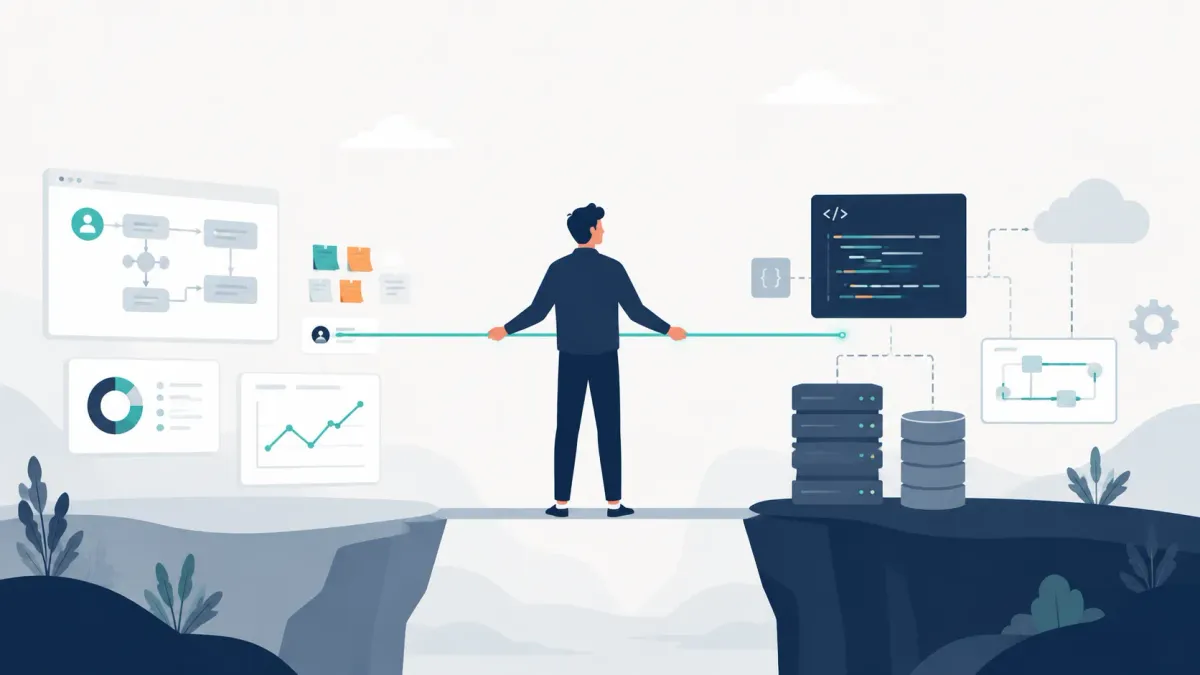
Let me start with the simple version: a technical product manager is still a product manager. The job is the same — understand what users need, work with a team to build it, and make sure it actually moves the needle. The difference is that a technical PM brings deeper technical fluency to that work.
That fluency is not about writing code. It is about understanding how systems behave, where constraints live, and what questions to ask when engineering and product priorities collide. It is about shortening the distance between a good idea and a shipped product.
This article is not going to tell you that you need a computer science degree to be a technical PM, because you do not. What I am going to tell you is what the role actually involves, when technical depth genuinely helps, and how to develop it if you want to move in this direction.
What a Technical Product Manager Does
A technical PM works on products where the underlying system complexity is high enough that shallow product understanding creates real problems. These are products where the decisions you make in a PRD have architecture-level consequences. Where a feature request that sounds simple on paper might require rethinking a core data model. Where your team cannot move fast if the PM cannot keep up with the conversation.
In this context, a technical PM does a few things that are different from a generalist PM:
Works on products with complex technical systems. APIs, microservices, data pipelines, infrastructure layers, developer tools — these are environments where the product and the technology are deeply intertwined. You cannot separate product decisions from technical ones.
Bridges product goals and engineering constraints. The best technical PMs I have seen are translators. They take a business goal and turn it into something the engineering team can reason about. And they take a technical constraint and explain its product implications to stakeholders who do not care about the system design.
Helps teams make better decisions faster. When a PM can read a technical spec, understand the tradeoffs being discussed, and ask the right question at the right moment — it saves hours. Decisions that would have required three meetings and two follow-up emails get made in a single conversation.
Understands architecture, APIs, data flows, and technical tradeoffs. This is not about knowing everything. It is about knowing enough to be useful. Knowing that adding a new data field has downstream consequences. Knowing that a synchronous API call in a high-traffic flow creates a latency risk. Knowing when an engineering estimate feels off and why.
How This Role Is Different From a Regular PM
The honest answer is: not as different as the job titles suggest.
A regular PM and a technical PM are doing the same fundamental job. The difference shows up in where they spend their attention and how they engage with engineering.
More technical depth. A regular PM might describe a feature at the user story level and hand it to engineering to figure out implementation. A technical PM is often involved in the implementation conversation — not to dictate solutions, but to understand constraints and surface tradeoffs early.
More time on system-level thinking. Technical PMs think about how product changes ripple through a system. Adding a new user permission model sounds like a small feature. But if it touches authentication, logging, billing, and the API layer — it is a cross-cutting change that needs different planning.
Stronger involvement in feasibility discussions. When engineering says something will take three weeks, a regular PM might take that at face value. A technical PM can ask: "Is this three weeks because of the implementation itself, or because of a dependency on another team's API?" That one question changes the roadmap conversation.
Still responsible for outcomes, not just specs. This is the part people forget. Technical depth does not change the job description. You are still accountable for whether the thing you shipped actually worked. The technical knowledge is a tool, not the goal.
Related: Product Owner vs Product Manager: Real Differences Explained
Skills a Technical PM Needs
The skill stack for a technical PM is not dramatically different from any other PM. But a few skills get weighted more heavily:
Product thinking. Still the foundation. Technical knowledge without product judgment is just an engineer without accountability. You need to be able to define problems, prioritize tradeoffs, and build for outcomes — not just understand systems.
Technical fluency. Not coding ability. Fluency. The ability to read a technical document, understand a system diagram, and follow an engineering conversation without needing everything translated. This is learnable.
System design understanding. You do not need to design systems yourself. But you need to understand concepts like scalability, latency, data consistency, service dependencies, and API contracts well enough to ask intelligent questions.
Ability to talk to engineers clearly. This goes both ways. You need to understand what they are saying, and they need to trust that you understand it. Engineers lose confidence in PMs who nod along to technical discussions they clearly do not follow. Be honest about what you do not know. Ask the question. It builds more trust than pretending.
Prioritization. Technical products often have more invisible complexity than consumer products. Prioritizing well means accounting for technical debt, infrastructure work, and dependencies — not just user-facing features.
Communication. You are constantly translating. Engineering to business. Business to engineering. Users to teams. Technical context to stakeholders. The PM who communicates clearly is the PM who unblocks everyone else.
Comfort with ambiguity. Technical products are full of unknowns. Specs change when new constraints emerge. Requirements shift when the architecture does. The ability to hold ambiguity without freezing is a core PM skill, and it matters even more in technical environments.
What Technical Depth Actually Looks Like
When people say "technical depth," it sounds abstract. Here is what it looks like in practice:
Understanding APIs and integrations. Knowing that two systems communicate through an API means knowing that a change in one system's response format can break the other. When a partner integration goes down, a technical PM knows whether it is a contract issue, a version mismatch, or a rate limit problem. That knowledge shapes how you respond and how you communicate the issue to stakeholders.
Reading logs, dashboards, or metrics. A technical PM can open a monitoring dashboard and understand what they are seeing. Error rates, latency percentiles, database query times. You are not debugging the issue — but you can tell whether it is big or small, and whether it is getting better or worse.
Knowing how product changes affect systems. Adding a new filter to a search feature sounds trivial. But if that filter requires a full table scan on a large dataset with no index, you have just introduced a performance problem at scale. A technical PM catches this before the sprint starts, not after the feature ships.
Asking better questions in engineering discussions. The best contribution a technical PM can make in a design review is a question like: "What happens to existing users' data when this migration runs?" or "How does this behave if the third-party API is slow?" These are not expert-level questions. They are informed questions. And they change the output of the meeting.
Spotting risks earlier. Technical PMs tend to surface risks earlier in the product cycle because they can see where complexity lives. They do not wait for engineering to flag a problem two days before launch. They build time for the hard parts into the plan from the start.
Day-to-Day Work of a Technical PM
Here is what a real day looks like — not a sanitized version, but an honest one:
Morning. You start by checking metrics. Not just product metrics — also system health. Are error rates up? Did something break overnight? Is there an incident in progress? If there is, your first hour is probably spent understanding the scope, communicating status to stakeholders, and helping the team prioritize the fix. If everything is clean, you move to the backlog. What is blocked? What decisions are waiting on you?
Midday. This is usually where the engineering collaboration happens. Refinement sessions, design reviews, or one-on-ones with tech leads. You are going deep on scope, surfacing dependencies, and helping the team break down complex work into shippable pieces. A typical conversation might be: "We want to add real-time notifications. What does that require from the backend? How does it interact with the existing event system? What is the cheapest version of this we can ship to validate the use case?"
Afternoon. Writing time. Requirements, briefs, stakeholder updates. You are translating what you learned in the morning conversations into documents that non-technical stakeholders can act on. You might also be reviewing a design mockup and thinking through edge cases — what happens when the API returns an error? What does the user see during a loading state?
End of day. Unblocking. There are always decisions sitting in Slack or email that only you can make. You clear them. You also spend a few minutes on what tomorrow needs to look like — what is the one thing the team needs from you to keep moving?
Related: What Does a Product Manager Do Day to Day?
When You Need a Technical PM
Not every product needs a technical PM. But some products genuinely do, and putting a non-technical PM on these teams creates slow, painful friction.
Complex platforms. Products where multiple systems interact, where architecture decisions have long-term consequences, and where engineering velocity depends on the PM understanding the system.
Developer tools. When your user is a developer, your PM needs to think like one — at least partially. Understanding how developers integrate, what good documentation looks like, and how API design affects the user experience is not optional.
Infrastructure-heavy products. Cloud products, data infrastructure, security tools. These are areas where the product and the technology are the same thing. A PM who cannot follow the technical conversation cannot lead the product.
Data products. Building dashboards, analytics tools, or ML-powered features requires understanding how data moves, what it means, and where it can mislead. A technical PM on a data team knows when a metric is being measured incorrectly and why that matters.
Products with many integrations or backend dependencies. The more your product depends on other systems — internal or external — the more important it is to have a PM who understands what those dependencies mean for reliability, scope, and speed.
When People Overvalue the Title
Here is the honest counterpoint: not every PM needs to be deeply technical, and calling yourself a technical PM does not make you a better one.
I have seen engineers transition into PM roles and struggle because they kept solving technical problems instead of product problems. They could design a beautiful system architecture but could not answer the question: "Why does this matter to the user?"
Technical depth is a multiplier. It amplifies good product judgment. It does not replace it.
A weak PM with strong technical knowledge is still a weak PM. They will build technically elegant products that nobody wants. They will optimize systems that are solving the wrong problem. They will impress engineers while frustrating users.
Product judgment still comes first. Technical fluency is the layer you add on top.
How to Become a Technical PM
If you want to move toward this role, here is the sequence that actually works:
Build strong product basics first. If you are not already comfortable with discovery, prioritization, PRDs, and stakeholder management — start there. Technical knowledge without a product foundation is just engineering with extra steps.
Learn systems thinking. You do not need to study computer science. But read about how web applications work, how APIs are structured, how databases store and retrieve data. There are excellent free resources for this written specifically for non-engineers.
Get comfortable with APIs, data, and architecture basics. Use tools like Postman to make API calls. Read API documentation for a product you use. Open a data dashboard and figure out what you are looking at without asking for help. These small habits compound quickly.
Work closely with engineering teams. The fastest way to build technical fluency is to sit in engineering conversations and ask questions. Be the PM who shows up to the architecture review, not just the sprint planning. Be curious, not performative.
Build products or side projects to learn faster. Nothing teaches you the reality of technical constraints faster than shipping something yourself. It does not need to be complex. Build a small tool. Launch something. Hit a constraint. Figure out how to work around it. That experience is worth more than any course.
Final Takeaway
Technical product managers add value because they reduce friction between product and engineering. They shorten the translation loop. They ask better questions earlier. They catch risks before they become incidents.
But the job is still about building the right thing, not just understanding how to build it. Technical fluency is a tool you use to do better product work. It is not the point of the work itself.
If you are a PM who wants to grow in a technical direction — start small, stay curious, and measure your progress by whether engineering teams trust you more, not by whether you can explain a microservices architecture at a dinner party.
That is the real signal.
Spotted something outdated or wrong?
Report an issue
We hate ads too. Sign up free to remove them








Comments